
Urban Dispatch Director
Developer: New Pixel Core
Published: 2026-09-30
Updated: 2026-09-30
About
Urban Dispatch Director targets players who enjoy planning and resource management rather than action. Its strengths lie in the constant flow of incident reports, the need to match teams to specific problems, and the pressure of limited units. The browser format and simple controls lower the barrier to entry. The main limitation is that the source material does not detail progression systems, difficulty scaling, or the exact comparison feature, so depth beyond the core dispatch loop remains unclear.
Reading the Incoming Calls
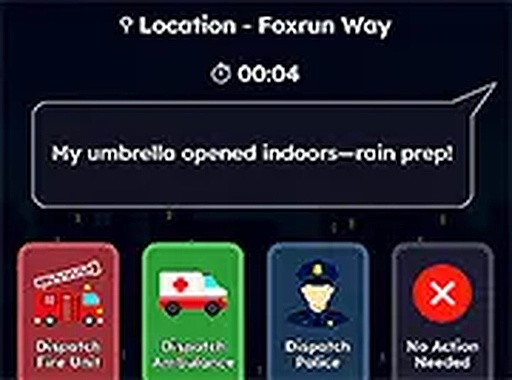
Every incident arrives as a short message tied to a location on the city map. You read the summary, identify what kind of help is needed, and decide whether it is a medical, traffic, or property-related matter. The stream of alerts never stops for long, so staying organized matters as much as making the right call.Matching Teams to Incidents
Each available unit has a defined function, and sending the wrong one wastes time you cannot easily recover. You weigh the nature of the problem against the urgency of the case, handle the most pressing matters first, and keep an eye on units already in the field. The challenge comes from doing this while new calls keep arriving.Managing Limited Resources
You cannot send every team to every incident. Some situations need an immediate response; others can wait briefly without serious consequences. The game asks you to think ahead, balancing current demands against what might arrive next. Over repeated sessions, you build a feel for which events require a swift reaction and which tolerate a slower, more measured approach.Reviewing Your Decisions
After a session, you can look back at how your choices affected outcomes. The game may include a system for comparing your efficiency with other players globally, which gives you a benchmark and a reason to refine your strategy. Response time and accuracy in team selection are the kinds of areas you can examine and improve. The feedback loop is designed to sharpen your problem-solving over time.Approachable Controls and Audience
The interface uses clear visuals and simple controls that work with both mouse and touch. There is no disturbing content, and the game runs entirely in a web browser with no installation. Sessions can be short or long, and the focus stays on thoughtful decision-making rather than fast reflexes, which makes it accessible to a wide range of players.Compatibility
Play on Any Device | Chrome / Safari / Edge Recommended
FAQ
What type of game is Urban Dispatch Director?
It is a management and strategy game set in a city response network. You monitor incoming incident reports, assess each situation, and assign the appropriate team from your available resources. The core loop is reading, prioritizing, and dispatching rather than action or reflex-based play.
Do I need to install anything to play Urban Dispatch Director?
No. The game runs entirely in a web browser, so there is no download or installation step. You can open it and start a session whenever you have time, whether that is a few minutes or a longer stretch.
What skills does Urban Dispatch Director test?
The game emphasizes prioritization, resource allocation, and decision-making under a constant flow of information. You judge urgency, match teams to incident types, and manage limited units. Fast reflexes are not the focus; staying organized and thinking ahead are more important.
Is Urban Dispatch Director suitable for children?
The input describes the game as having no disturbing content and an interface built to be approachable for players of all ages. Controls work with mouse and touch. Parents can reasonably expect a non-violent management experience focused on coordination and planning.
Can I compare my performance with other players?
The game may include a system that lets you compare your efficiency with other players globally, according to the source description. This feature provides a benchmark for progress and can motivate you to refine your strategies, though the exact implementation is not detailed.
What happens if I send the wrong team to an incident?
The source material states that matching the right unit to the right incident is critical and that each team has a defined function. Sending the wrong unit likely wastes time and resources, but the exact penalty is not specified. The game encourages careful assessment before dispatching.
Comments
Sign in to comment
You must be logged in before posting a review or rating.
No comments yet. Be the first to comment!





Editorial Notes